
Oct
Resources & Guides
Brix Refractometers Explained: How They Work, Types and Uses
What Is a Brix Refractometer?
A Brix refractometer is a measuring instrument used to estimate the concentration of dissolved solids in a liquid by measuring how light is refracted as it passes through the sample. In many food, agricultural and beverage applications, the dissolved solids are predominantly sugars, which is why Brix is commonly associated with sugar content.
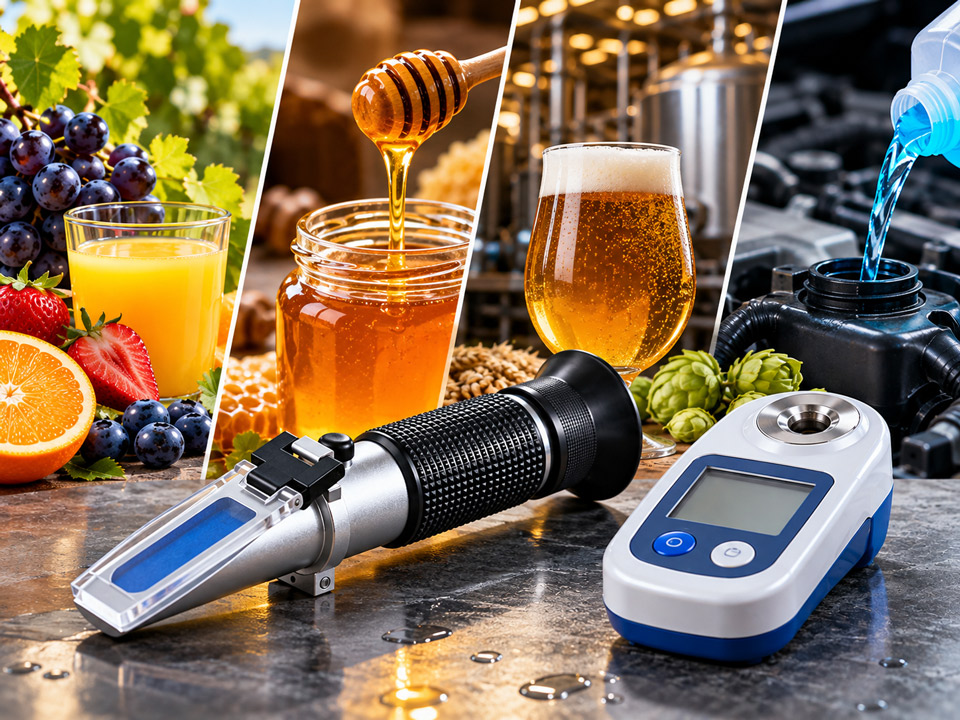
Brix refractometers are widely used for testing fruit, fruit juice, beverages, syrups and other liquid samples. They provide a fast measurement using only a small amount of sample, making them useful for both field measurements and routine quality control.
There are several types of refractometers, including traditional analogue handheld instruments and digital refractometers. Although they work on the same fundamental principle of light refraction, their measurement ranges, scales and intended applications can differ considerably.
What Does Brix Actually Measure?
Degrees Brix, written as °Bx, represents the percentage by mass of sucrose in a sucrose-and-water solution. A solution containing 10 grams of sucrose in 100 grams of solution corresponds to 10 °Bx under the reference definition.
Real-world samples, however, often contain substances other than sucrose. Fruit juice, for example, can contain several sugars as well as acids, minerals and other dissolved compounds. A refractometer therefore measures refractive index and converts that measurement into a Brix value. In these applications, Brix should generally be understood as an estimate of total soluble solids rather than a laboratory-specific measurement of sucrose alone.
This distinction is important when interpreting results. A higher Brix reading usually indicates a greater concentration of dissolved solids, but it does not necessarily mean that every percentage point represents exactly the same amount of sugar in a complex sample.
How Does a Refractometer Work?
When light passes from one material into another, its direction changes. This phenomenon is known as refraction. The amount of refraction depends partly on the composition and concentration of the liquid being tested.
A refractometer uses this relationship to determine the refractive index of a sample. In a Brix refractometer, the result is displayed or interpreted on a Brix scale.
Only a few drops of liquid are normally required. With a traditional optical refractometer, the sample is placed on the prism and viewed through the eyepiece. The user reads the value at the boundary between the light and dark areas of the scale. A digital refractometer detects the optical response electronically and displays the calculated measurement on a screen.
Analogue vs Digital Refractometers
One of the first decisions when choosing a refractometer is whether an analogue or digital instrument is more suitable. Both can provide effective Brix measurements, but each format has practical advantages.
Analogue Refractometers
Analogue refractometers, sometimes called optical or handheld refractometers, are compact instruments that normally require no batteries. A liquid sample is placed on the prism, the cover plate is closed and the instrument is pointed towards a suitable light source. The Brix value is then read through the eyepiece.
Their simple construction makes analogue refractometers particularly convenient for field measurements, agricultural work, incoming produce checks and applications where a portable instrument needs to be used repeatedly without relying on electronic components.
Different models are designed for different Brix ranges. A relatively narrow-range refractometer can provide an appropriate scale for low-Brix samples, while higher-range models are required for concentrated products such as syrups and other high-solids liquids.
Digital Refractometers
A digital refractometer performs the optical measurement electronically and displays the result directly on a digital screen. This removes the need for the operator to visually determine the boundary line on an analogue scale.
Digital models can be particularly useful when measurements are taken frequently, when several operators use the same instrument or when easy-to-read results are important for routine quality-control procedures.
For businesses comparing different measurement ranges and instrument formats, our analogue and digital refractometers include models suitable for a variety of Brix and refractive-index based applications.
What Are Brix Refractometers Used For?
Brix measurement is used across agriculture, food production, beverage manufacturing and quality control. The appropriate instrument and measurement range depend heavily on the type of sample being tested.
Fruit, Juice and Fresh Produce
One of the best-known applications of Brix measurement is evaluating fruit and fruit juice. As fruit develops and ripens, its soluble solids concentration changes. Measuring Brix can therefore provide useful information for growers, buyers, processors and quality-control teams.
Common applications include grapes, citrus fruit, berries, melons, apples and many other types of fresh produce. Measurements can be taken from extracted juice to help compare batches, assess maturity and monitor consistency.
Brix should not be treated as a universal measurement of fruit quality on its own. Acidity, variety, maturity, growing conditions and other characteristics also influence flavour and overall quality. It is best used as one measurable parameter within a broader quality assessment.
Food and Beverage Production
Refractometers are also widely used during the production of juices, soft drinks, sauces, concentrates, jams, syrups and other foods containing dissolved solids.
Routine Brix measurements can help manufacturers check ingredient concentration, compare batches and monitor whether a product remains within the expected process range. Because only a small sample is required and results can be obtained quickly, refractometers are particularly convenient for repeated production checks.
Brewing and Fermentation
Refractometers can be used to measure the concentration of dissolved sugars in wort, must and other liquids before fermentation. This makes them useful in brewing, winemaking and similar processes where sugar concentration is an important starting parameter.
Measurements taken after fermentation begins require more careful interpretation. Alcohol changes the refractive index of the liquid, so a direct refractometer reading can no longer be interpreted in exactly the same way as an unfermented sugar-and-water sample. Appropriate correction methods may therefore be necessary when using refractometer readings during fermentation.
Can You Measure Honey with a Brix Refractometer?
Honey is another product commonly tested using refractometry, but selecting the correct instrument is particularly important.
Honey contains a very high concentration of dissolved sugars and relatively little water compared with fruit juice. Standard low-range Brix refractometers may therefore be unsuitable because the sample can fall outside their measurement range.
Dedicated honey refractometers are commonly designed with scales appropriate to honey, often allowing users to assess moisture or water content as well as high soluble-solids concentrations. Moisture is an important quality parameter because excessive water can increase the risk of fermentation and affect the storage stability of honey.
For this reason, a refractometer should not be selected simply because it has a Brix scale. Always check that its measurement range and scale are appropriate for honey or any other high-concentration sample you intend to test.
What About Antifreeze Refractometers?
Refractometers are not limited to measuring sugar solutions. The same optical principle can also be used to evaluate the concentration of automotive and industrial fluids.
An antifreeze refractometer is designed to measure coolant or antifreeze solutions and typically uses scales appropriate to fluids such as ethylene glycol or propylene glycol. Depending on the instrument, the scale may indicate concentration, freezing-point protection or another application-specific value.
This is an important distinction: an antifreeze refractometer is not simply a standard Brix refractometer being used for coolant. The instrument’s scale must correspond to the type of fluid being tested.
Antifreeze refractometers are useful in vehicle maintenance, workshops, cooling systems and other applications where coolant concentration needs to be checked. If both food-related Brix measurement and coolant testing are required, separate instruments or an appropriately designed multi-scale refractometer should be selected.
Understanding Brix Measurement Ranges
Not every Brix refractometer measures the same range. Choosing the correct range is one of the most important considerations when selecting an instrument.
Low and medium Brix ranges are commonly suitable for fruit, juices and many beverages, while higher ranges are needed for concentrated solutions such as syrups, preserves and honey-related applications. Some instruments provide a broad measurement range, while others concentrate on a narrower range for a particular type of sample.
A wider range is not automatically better. The most appropriate refractometer is one whose measurement range comfortably covers the samples you actually need to test while providing the resolution required for your application.
What Is Automatic Temperature Compensation?
Temperature affects refractive index, which means it can also affect a Brix measurement. Many handheld refractometers therefore include Automatic Temperature Compensation, commonly abbreviated as ATC.
ATC is designed to compensate for temperature-related changes within the operating range specified by the manufacturer. It can make routine measurements more convenient, particularly when testing samples outside tightly controlled laboratory conditions.
However, ATC should not be interpreted as meaning that sample temperature never matters. Instruments have specified operating and compensation ranges, and very large temperature differences between the sample, prism and surrounding environment can still affect measurement stability. For best results, always follow the manufacturer’s operating instructions.
How to Measure Brix with a Refractometer
The exact procedure varies between instruments, but a typical Brix measurement involves a few straightforward steps.
- Make sure the refractometer prism is clean.
- Calibrate the instrument according to the manufacturer’s instructions.
- Place a small, representative sample on the prism.
- Ensure the sample covers the required measurement area without contamination or excessive air bubbles.
- Take the measurement using the eyepiece on an analogue refractometer or the measurement control on a digital model.
- Record the Brix result.
- Clean and dry the prism after measurement using a method suitable for the instrument and sample.
Consistency is important. Samples should be representative of the product being tested, and the prism should be properly cleaned between measurements to prevent residue from affecting subsequent readings.
How to Calibrate a Brix Refractometer
Calibration procedures vary by model, so the manufacturer’s instructions should always take priority. Many handheld Brix refractometers can be checked or calibrated using distilled or deionised water, while some applications and measurement ranges may require an appropriate reference solution.
For an optical refractometer, calibration commonly involves applying the reference liquid to the prism and adjusting the instrument until the expected value is obtained. Digital instruments generally provide a calibration function that performs the corresponding adjustment electronically.
Calibration should be checked periodically and whenever measurement accuracy is in doubt. It is also sensible to check calibration after significant changes in operating conditions or before an important series of measurements.
How to Choose the Right Refractometer
The best refractometer depends on what you intend to measure rather than simply whether a model is described as analogue or digital. Before selecting an instrument, consider the sample type, expected measurement range, required resolution, temperature conditions and how frequently measurements will be taken.
For fruit and juice testing, a handheld Brix refractometer with an appropriate low-to-medium measurement range may be sufficient. Higher-concentration products require a correspondingly higher Brix range. Honey testing may require a dedicated high-range or moisture-scale instrument, while antifreeze and coolant testing requires scales specifically designed for those fluids.
An analogue refractometer can be an excellent choice when simplicity, portability and battery-free operation are priorities. A digital refractometer may be preferable when rapid readout, ease of interpretation and repeatable routine measurements are more important.
Brix Refractometers: A Simple Measurement with Many Applications
Refractometry provides a fast and practical way to evaluate the concentration of liquids using only a very small sample. Brix refractometers are particularly useful in fruit growing, food processing, beverage production and quality control, while application-specific refractometers extend the same optical measurement principle to products such as honey and antifreeze.
The key is selecting the correct instrument for the sample. Measurement range, scale, temperature compensation and instrument type should all be considered before choosing a refractometer.
Explore Techno London’s range of refractometers to compare analogue and digital instruments for Brix measurement, food and beverage testing, antifreeze testing and other refractive-index based applications.